July 2026 · 8 min
Varanasi: The City That Refuses to Hurry
On three thousand years of continuity, a river that doesn't perform, and why the best thing you can do here is sit.
There is a particular kind of vertigo that hits you on the ghats around 5 a.m., before the sun has decided whether it's coming up or not. It isn't the crowd, though there is one. It's the arithmetic. Someone will tell you, almost casually, that people have been performing rites on this exact stretch of riverbank for three thousand years, and your brain simply refuses to hold the number. Rome feels young standing next to this city.
A city older than the idea of cities
Varanasi — Kashi, Banaras, depending on who you ask and which century they're speaking from — is routinely named among the oldest continuously inhabited cities on earth. What makes the claim land differently here is that the age isn't sealed behind glass. The same steps pilgrims descended centuries ago are the steps a boatman uses today. The same lanes that housed silk weavers still smell of the same dye vats. Nothing has been preserved for you to look at. It has simply never stopped.
So this isn't a set of monuments to tick off. It's a working system — religious, commercial, funerary, domestic — that happens to also be extraordinary to witness, and it will not adjust itself for you.
The river doesn't ask permission
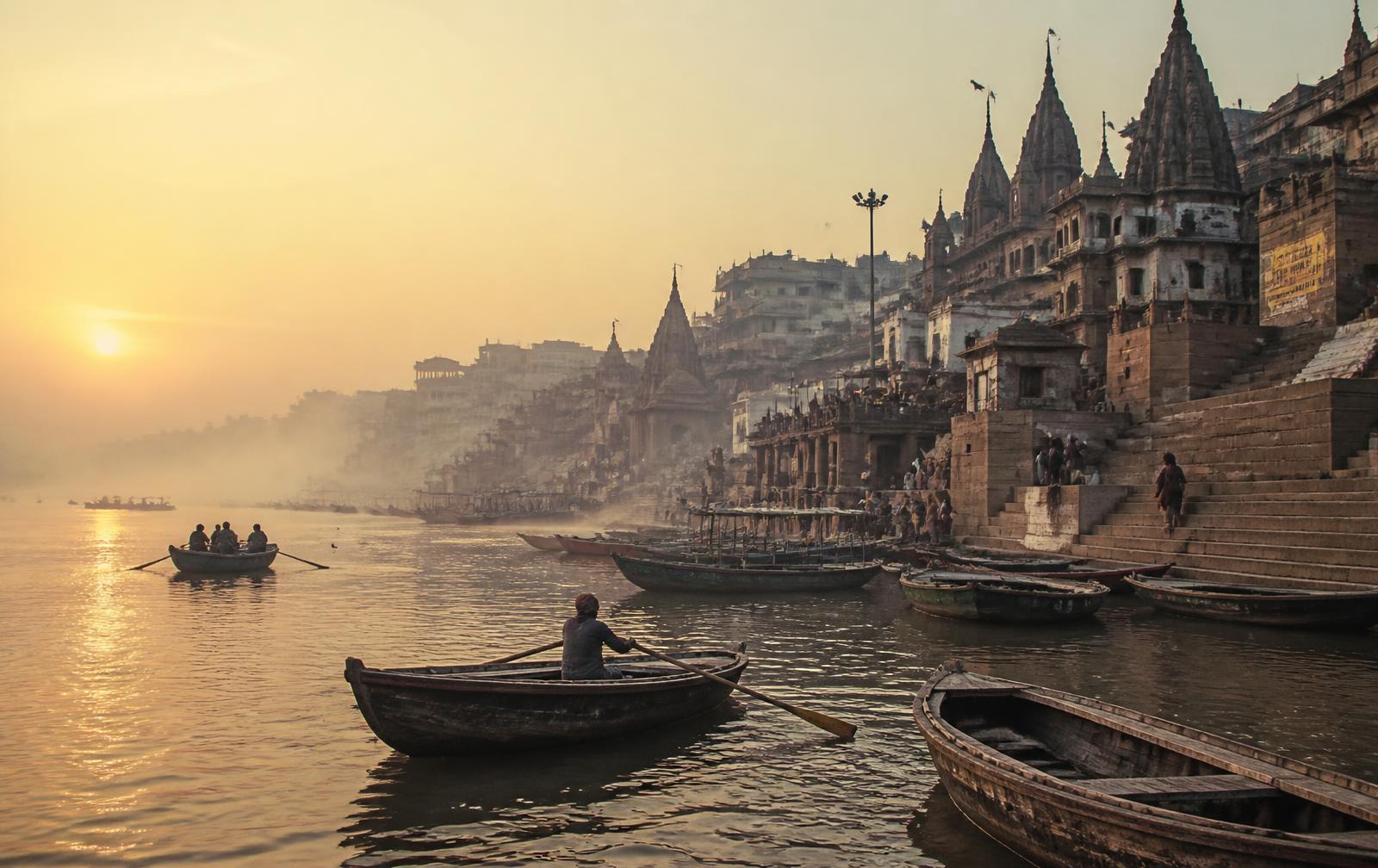
The Ganga here isn't scenery; it's the reason the city exists, and it behaves like it knows this. Wide, brown-green, moving with a weight that feels almost muscular, it carries ash, marigolds and the reflected fire of a hundred lamps while the city arranges itself along the western bank like an audience that has been sitting in the same seats for millennia.
Belief holds that dying here, or having your ashes released into the river, is a shortcut out of the cycle of rebirth. That isn't an abstraction you read in a pamphlet — it's visible. Manikarnika and Harishchandra cremate around the clock, and the smoke genuinely hangs over parts of the riverfront. It is worth sitting with rather than looking away from.
Death here isn't hidden the way most cities hide it. It's part of the daily choreography of the ghats.
Time moves differently
Part of it is practical: the old city's lanes are too narrow for cars, so you walk, and walking means being interrupted constantly by cows, temple bells, chai stalls, funeral processions, wedding processions, and men carrying impossibly large loads of marigolds on bicycles. You cannot rush this.
But sit on the steps at Assi with a cup of chai as the light changes over two or three hours and you notice that nobody around you is checking a watch. Priests move at ritual pace. Boatmen wait for the boat to fill. Old men play cards for the length of an afternoon. It isn't laziness — the river's slowness has quietly become the template for how everything else here moves.
What we would actually do with three days
One boat at first light, because seeing the ghats from the water gives you the city's whole geography at once. One evening at the Ganga Aarti at Dashashwamedh, arriving early enough to sit. A long unstructured walk along the riverfront on foot, end to end, which reveals what a boat misses. Sarnath for a morning, ten kilometres out, where the Buddha gave his first sermon and the pace turns green and open. Food chosen by the length of the local queue, never the English sign.
And then the part most itineraries leave out: an hour on a ghat with a chai and no agenda. Varanasi doesn't try to convince you of anything. It has already solved the problem of eternity, and is simply waiting, unhurried, for the rest of us to catch up.
Curious what a trip through Varanasi could look like?