August 2026 · 8 min
Ranthambore: Where the Tiger Still Rules
On a fort that became a forest, a hunting ground that became a sanctuary, and the minutes when you are simply tolerated.
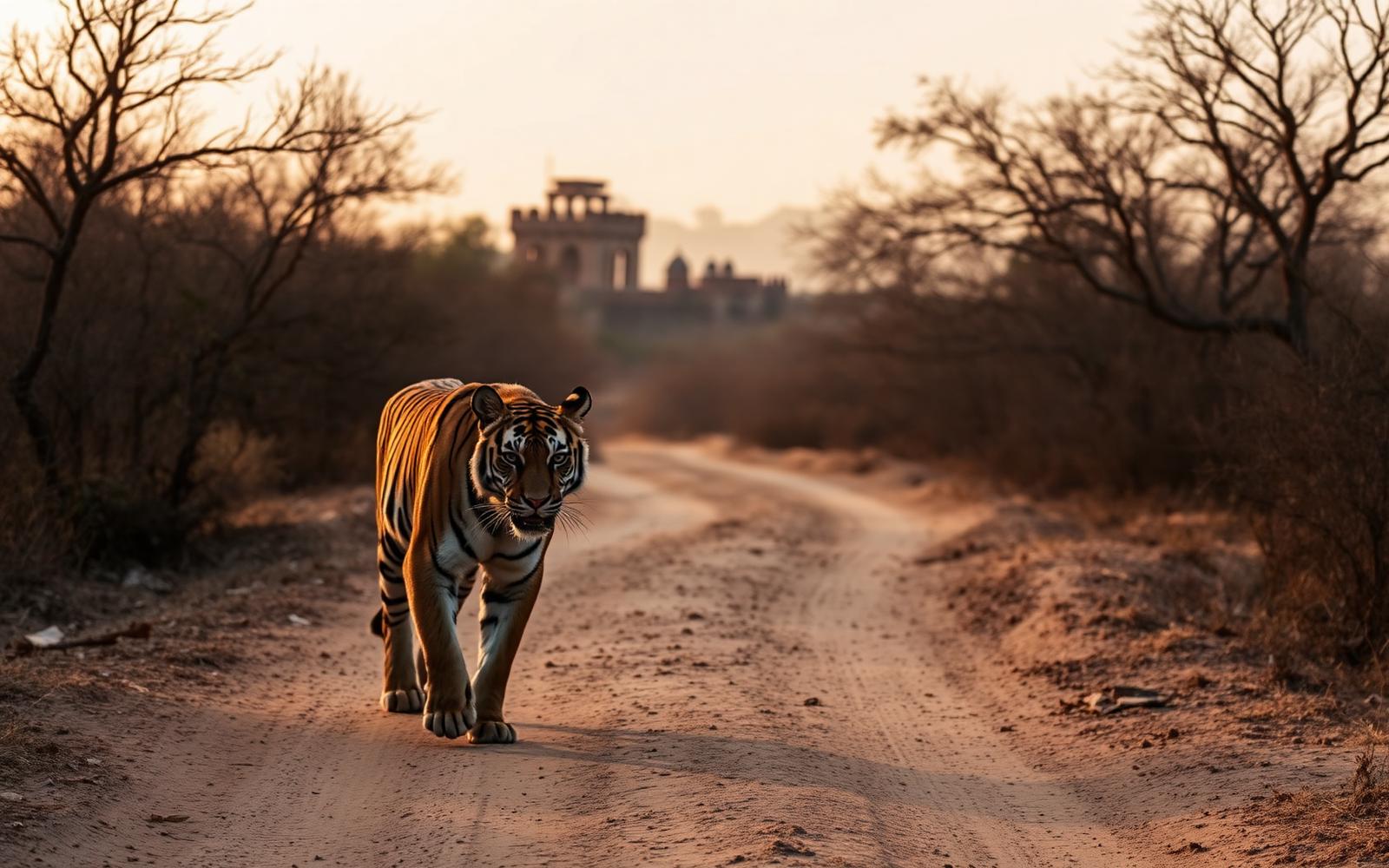
There is a specific kind of silence that falls over a jeep in Ranthambore right before someone spots a tiger — not the silence of nothing happening, but of everyone realising, at once, that they are no longer the ones in charge. You came looking for the tiger. The tiger decides whether that search ends in anything.
The tigers here are famously unbothered by jeeps, walking along dirt tracks in full daylight, sometimes close enough that guides go quiet out of instinct rather than instruction. You are not watching from a distance. You are, for a few minutes, simply tolerated.
A fort first, a forest around it
Long before this was tiger territory, it was king territory. Ranthambore Fort sits on a hilltop inside the park, its construction believed to have begun in the 10th century, walls rising nearly seven hundred feet above the forest floor. For centuries it changed hands between Rajput clans, the Delhi Sultanate and the Mughals, each leaving behind gates, stepwells and temple shrines — including the Trinetra Ganesh Temple, one of the few in the world where the deity is shown with a third eye, and still an active pilgrimage site inside tiger territory.
When the fort's military relevance faded, the jungle around it became a royal hunting ground. The Maharajas of Jaipur used these forests for shikar for generations, and colonial-era viceroys were brought here as honoured guests for the same purpose. Jogi Mahal, at the edge of Padam Talao, is the clearest survivor — once a hunting lodge, later a guesthouse, now a quiet ruin beside the lake. Nature didn't erase this history; it moved in alongside it, so a dry riverbed of pugmarks can round a corner into a five-hundred-year-old archway with banyan roots working through the stone.
The shift from shikar to sanctuary came in the 20th century: a wildlife sanctuary in 1955, a national park in 1980, folded into Project Tiger soon after. It worked. Ranthambore is now one of the most reliable places on earth to see a wild tiger, helped by the fact that its tigers stay active by day rather than strictly at night. Much of its global fame traces to one tigress, Machli, who ruled the park's lakes for over a decade until her death in 2016 and became a documentary star in her own right.
Who has come looking
Ranthambore's reputation reaches well past the wildlife-photography crowd. Bill Clinton visited in 2000 while in office; Hillary Clinton made her own visit years later. In 2010 the park briefly turned wedding venue when Katy Perry and Russell Brand held their ceremony at its edge with an eighty-strong entourage. A fitting footnote for a place that has always staged itself for the powerful — kings once came here to hunt, and now the world's public figures come simply to look.
You came looking for the tiger. The tiger decides whether that search ends in anything.
How we would actually do it
A six-seat gypsy rather than a canter, because it reaches the narrower tracks and moves at the pace of what is actually happening. Early mornings for the light as much as the wildlife — mist over Padam Talao at sunrise earns the alarm on its own. A second safari in one of the quieter zones, six to ten, where the convoys thin out. A non-safari morning climbing the fort, which is a genuine UNESCO site rather than a token add-on. And a slow hour at the Raj Bagh ruins at golden hour, when the light comes through the broken archways and the forest does the rest.
Curious what a trip through Ranthambore could look like?