August 2026 · 9 min
The Blue Mountains: Ooty, Coonoor, and the Art of Being Cool
On tea slopes, a toy train that is slow by design, and why Coonoor rewards the overnight more than Ooty.
There is a particular moment on the drive up from Mettupalayam when the plains simply give up. The heat that has been pressing against the windows for hours thins out, the road begins to fold into itself in hairpin after hairpin, and somewhere around the two-thousand-metre mark the air changes character entirely. It stops being weather and starts being a presence — cool, damp, faintly sweet with eucalyptus.
The Nilgiris — the Blue Mountains — take their name from the haze that settles over them at a distance, a blue-grey wash the Toda people watched for generations before the British ever climbed up looking for relief from Madras summers. That colonial instinct is still written into Ooty and Coonoor's bones: Gothic churches, clipped hedges, cottages with sloped roofs pretending, at 2,200 metres, to be somewhere in Surrey. But underneath the borrowed architecture is something entirely its own, and it's the tea.
Two hill stations, two temperaments
Ooty and Coonoor sit less than twenty kilometres apart, connected by a road that unspools through some of the most photographed tea country in India, and yet they hold themselves very differently. Ooty is the hill station that got famous — the one from a hundred films, with the lake and the boat rides and weekend crowds thick enough that you queue for a photograph. It has real charms, but it has also learned to perform for visitors, and performance changes a place.
Coonoor never quite learned that trick, or didn't bother. It is smaller, slower, and the tea gardens don't stop at the edge of town for a market square — they run right up to the back gardens of the colonial bungalows, so you can stand on a porch with a cup of Nilgiri tea and look directly into the slope where it was grown. If Ooty is the Nilgiris dressed for visitors, Coonoor is the Nilgiris in its house clothes.
The tea slopes
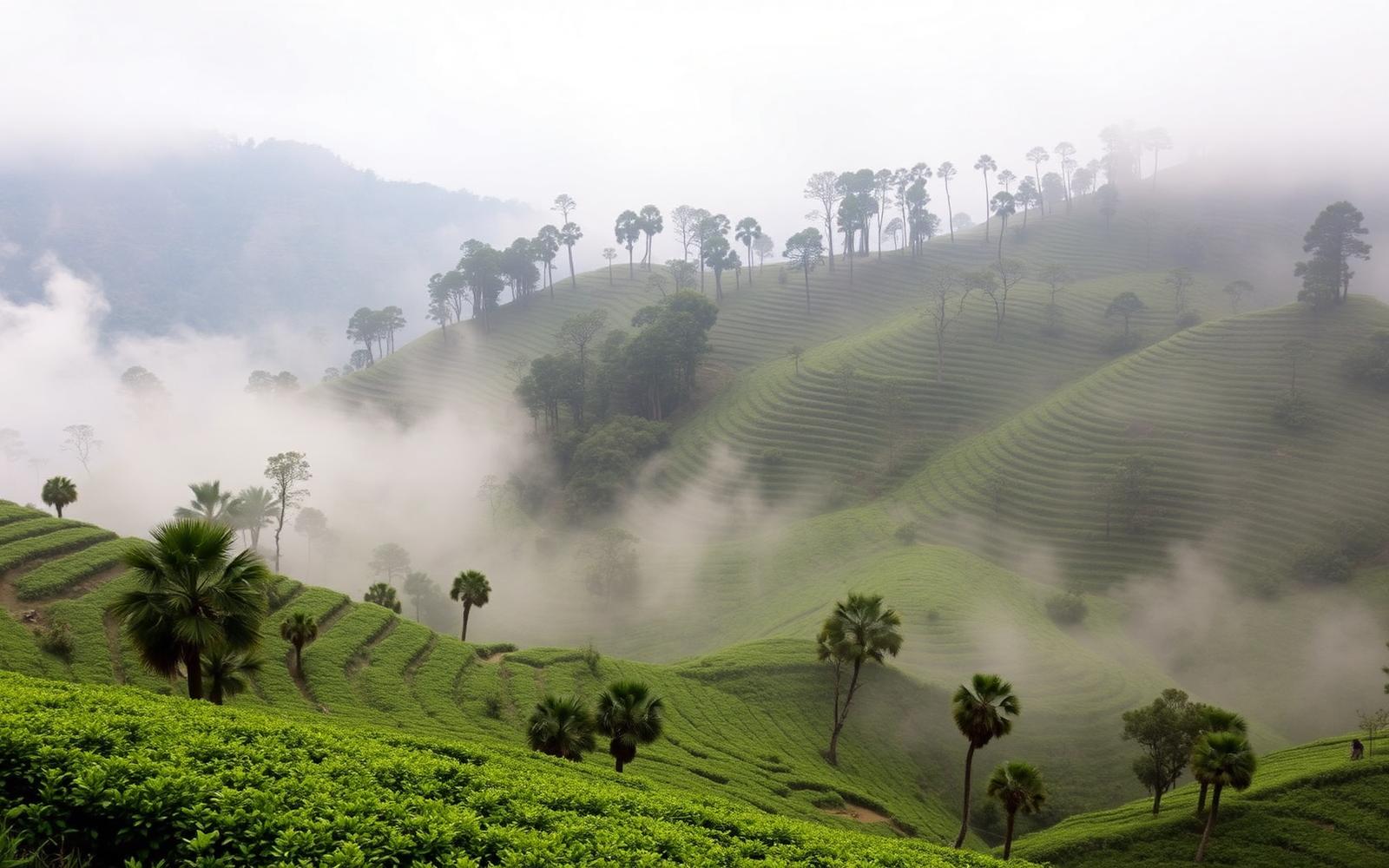
Nothing prepares you for the first proper view of a working estate. The slopes are terraced into impossibly even waves of green, pruned flat-topped by generations of pickers into a texture that from a distance looks upholstered. Up close it's different: rows of glossy-leafed bushes waist to shoulder high, narrow footpaths worn between them, and in the early morning women in bright sarees moving through the rows with baskets slung from their foreheads, picking two leaves and a bud at a time, the way it has been done here since the 1850s.
The light does something to this landscape it doesn't do anywhere else in India. Mist rolls through in sheets, clearing a single slope while the next valley stays hidden, so the whole place reveals itself in instalments. Late sun turns the tips of the bushes gold. It rains without warning and stops just as suddenly, and the smell that follows — wet earth, eucalyptus, and the faint green tannin of the leaves themselves — is worth the trip on its own.
It's not wilderness — almost nothing here is untouched — but it has been shaped with such long, careful hands that it reads as natural anyway.
What we would put in the days
Walk an estate rather than drive past one, with a tasting afterwards — Nilgiri tea is brisk and slightly citrusy and is meant to be drunk without milk to actually taste it. Ride the UNESCO-listed Nilgiri Mountain Railway, one of the steepest metre-gauge lines in the world, and sit on the right side heading up. Walk Sim's Park early, before the day-trippers. Take the light from Dolphin's Nose or Lamb's Rock at sunrise or just after rain. See a tea factory properly — withering, rolling, fermenting, drying — which reframes tea from a beverage into a craft. And drive out to Avalanche or Emerald, where the crowds vanish and the shola forest still stands.
Most visitors base themselves in one town and day-trip to the other. If there is room for only one overnight, Coonoor rewards it more generously, precisely because it asks less of you and gives more back.
Curious what a trip through Ooty & Coonoor could look like?