August 2026 · 8 min
Srinagar: The Valley That Argues With You
On grey-gold light on Dal Lake, gardens built as if heaven had right angles, and a history that refuses to stay in the background.
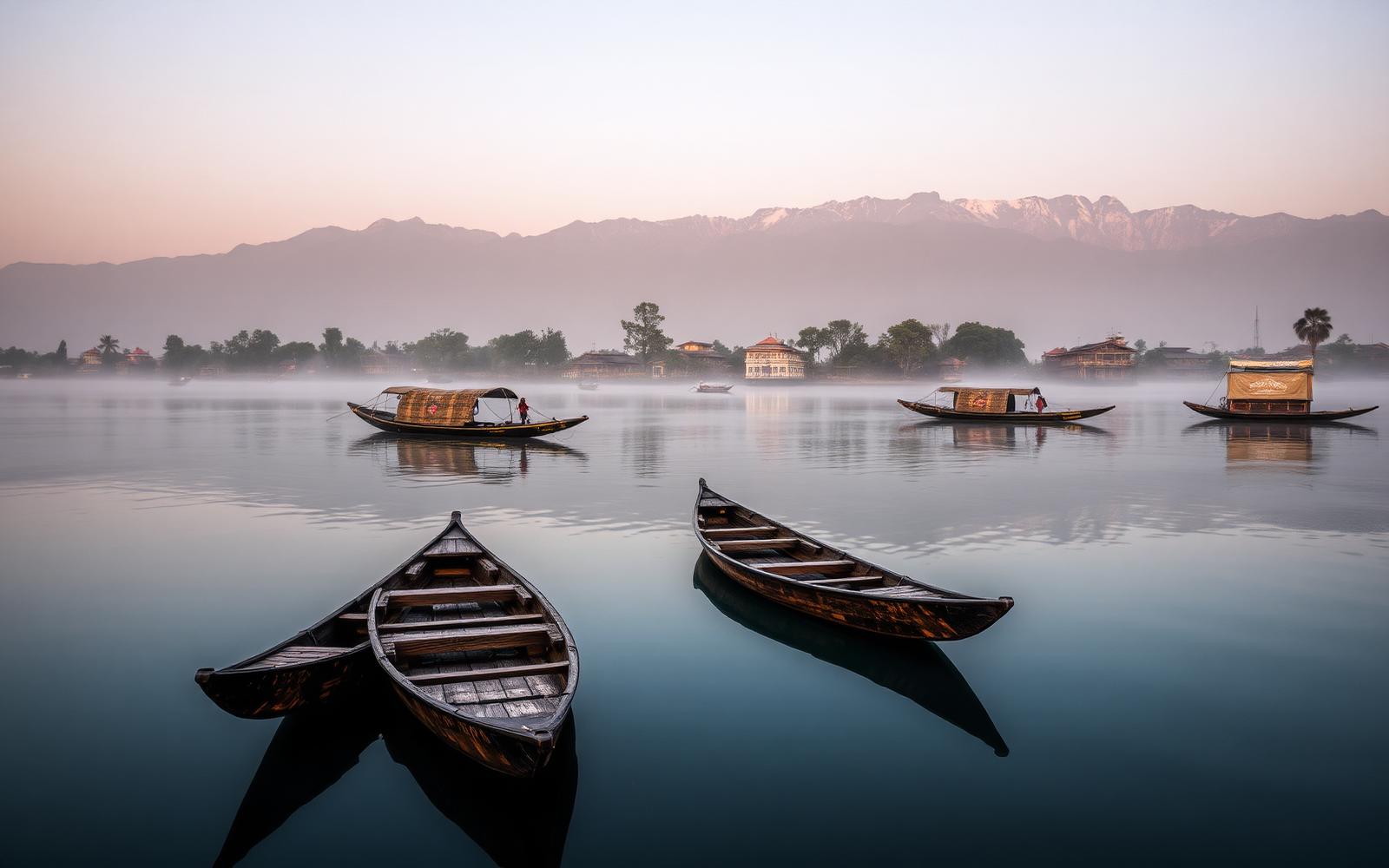
There is a particular kind of light that falls on Srinagar in the early morning — grey-gold, filtered through poplar leaves, sitting low on the water so that Dal Lake looks less like a lake and more like a held breath. You will see this light in every photograph ever taken of Kashmir, and it will still surprise you.
Srinagar confronts you with two things at once: a landscape so complete it feels designed, and a history so unresolved it refuses to be background. Most places you visit for one or the other — the view, or the weight. Srinagar gives you both.
The beauty that isn't an exaggeration
The Valley sits at a little over 1,500 metres, ringed by the Pir Panjal and Zabarwan ranges, so that mountains close the horizon wherever you stand. Dal Lake is the obvious centrepiece — houseboats carved from deodar wood, floating vegetable markets that begin before dawn, shikaras gliding between water lilies with the quiet of a boat that has no engine. It is exactly as beautiful as everyone tells you, and no amount of prior warning dulls it.
What surprises people more is the geometry the Mughals imposed on all this — terraced gardens at Nishat and Shalimar, water descending through chinar-shaded terraces in straight lines because the emperors who built them believed heaven had right angles. Chinar trees turn a deep rust-red in autumn and are so identified with the Valley that a dying one makes local news.
Beyond the city, the beauty gets more elemental. Gulmarg's meadows sit under Apharwat peak, snow-covered from December through March and startlingly green the rest of the year. Sonamarg — the meadow of gold — is the last stop before the high Himalaya begins. Pahalgam, gentler, sits where the Lidder river runs fast and cold through pine forest.
Most places you visit for one or the other — the view, or the weight. Srinagar gives you both.
The history that doesn't stay in the past
It would be dishonest to write about Srinagar as only meadows and lakes. Kashmir's modern troubles trace to Partition in 1947, when the princely state's accession to India was contested by Pakistan, triggering the first of several wars over the territory. A ceasefire line, later the Line of Control, split the region, and it remained one of the most militarised borders in the world for decades. From the late 1980s an armed insurgency took hold, bringing curfews and a security presence that shaped daily life for a generation. In August 2019 the Indian government revoked Article 370, which had granted the state special constitutional status, and reorganised it into two Union Territories — a move that remains politically contested and disputed by Pakistan.
The situation has changed substantially since then. Tourist arrivals have hit record numbers in recent years, new highway and rail links have opened up access, and the core circuit — Srinagar, Gulmarg, Pahalgam, Sonamarg — sees heavy footfall with a visible tourist-police presence. The region had a serious reminder of its fragility with a terror attack on tourists in Pahalgam in April 2025, which was met with widespread local condemnation and did not, in the end, keep travellers away. It is worth building trips around registered operators and checking current advisories before finalising dates — treating this as you would any place with a genuinely complicated recent past, with respect rather than either fear or performative fearlessness.
How we would actually do it
A shikara out before sunrise, when the lake is fog-still and the vendors are only just setting up. A proper wazwan, ideally somewhere that doesn't cook exclusively for visitors. A morning walking the old city around Jamia Masjid and Khanqah-e-Moula, where the architecture is Central Asian rather than Mughal. Pashmina, Kani shawls and papier-mâché bought from artisans directly. The Gulmarg gondola up to Apharwat. And kahwa — saffron and cardamom green tea — from a roadside stall rather than a hotel menu.
Practically: April to October for the gardens and the lake, December to March for snow in Gulmarg. Register your itinerary with your hotel, book ground transport through licensed local operators, and check current J&K Tourism advisories before fixing dates. Conditions on specific routes shift with weather and security updates in ways that rarely touch the core circuit, but are worth knowing in advance.
Curious what a trip through Srinagar & the Kashmir Valley could look like?