August 2026 · 9 min
Coorg: Land of Generals, Coffee, and a River's Birth
On a river guarded by the community that lives upstream of it, coffee grown under forest canopy, and a district with more soldiers per citizen than anywhere else in India.
Every river has a source, but few sources are guarded the way this one is. High in the Brahmagiri hills, inside a modest stone tank no larger than a temple courtyard, a spring feeds the beginning of the Cauvery — a river that will travel over 800 kilometres, irrigate two states, and decide the fortunes of millions of farmers before it reaches the sea. Here, at Talakaveri, it is still just water rising quietly out of rock, watched over by dense, unbroken forest on every side.
Coorg does not look like a place responsible for that much. It looks like a place that has simply been left alone. That, it turns out, is exactly the point. Officially Kodagu, this small hill district in Karnataka's Western Ghats has earned two titles that seem, at first, unrelated — the coffee capital of India, and the birthplace of one of the subcontinent's most contested rivers. Spend a few days here and you understand they were never separate stories.
A crop that arrived quietly, then took over
Coffee's journey into Kodagu is older and less tidy than the postcard version suggests. Long before British planters arrived, Mopla traders from the Kerala coast are believed to have carried coffee into the Nalknad region, where it grew first as forest produce — scattered, semi-wild plants bartered with coastal merchants for salt and cash, decades before anyone thought of it as an export crop. The transformation into an industry came after 1834, when the old Kingdom of Coorg was annexed into British India. Under colonial administration, coffee became an estate economy oriented toward London rather than Bhatkal. After independence, when European planters sold up, ownership passed largely to local and Kodava families, many of whom still run the same estates today.
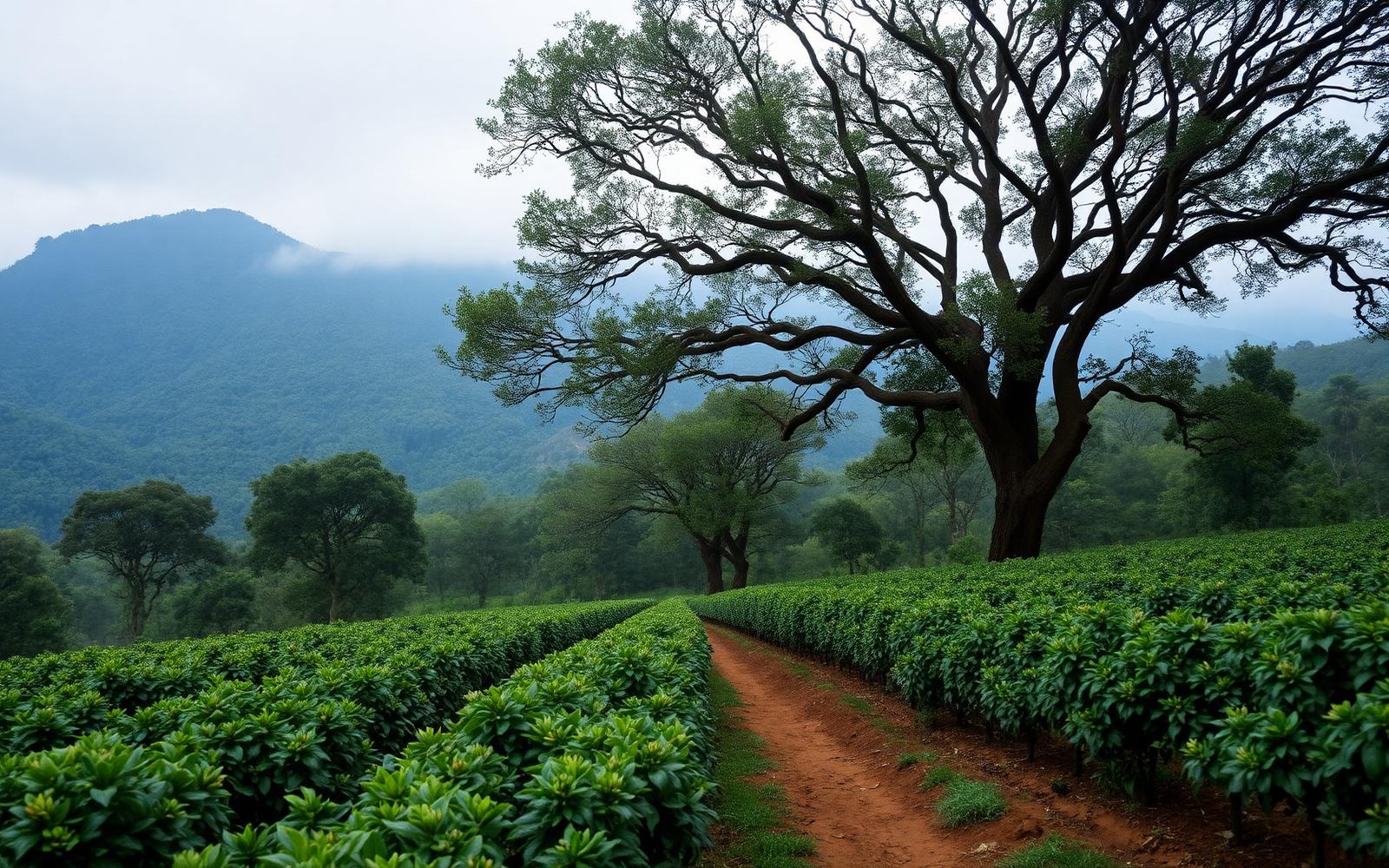
What makes Coorg's coffee distinctive isn't scale, though the numbers are considerable. It's the method. Arabica and Robusta here grow in the shade of silver oak and rosewood, under a partial forest canopy rather than open sun — slower, less efficient, and exactly why the beans carry that low-acid, earthy, faintly spiced character. The plantations aren't separate from the forest; they're threaded through it. Drive between estates and you rarely see a boundary between cultivated land and wilderness. One simply thins into the other.
A warrior lineage older than the estates
The same 1834 annexation that opened Kodagu to coffee also formalised something that predated the British by centuries: this is a warrior land. Kodava oral history traces martial custom back before 1100 AD, and Kodava fighters are remembered for repelling Hyder Ali's forces at a time when much of the surrounding region had already fallen to Mysore. The British recruited that tradition quickly, raising a dedicated Coorg unit as early as 1794 — a lineage that became the 71st Coorg Rifles and later the Coorg battalions of the two World Wars.
It did not end with independence; it defined it. Field Marshal K.M. Cariappa, independent India's first Indian Commander-in-Chief, was a Kodava, as was General K.S. Thimayya. For a community numbering under 200,000, the ratio of soldiers to citizens has no real parallel in the country, and Kodagu is still, informally, called the land of generals.
Coorg has spent two centuries defending a river it did not have to, and a country it did not always have to serve. Both habits appear to come from the same place.
It shows up in small ways that have nothing to do with parades. Kodava men are traditionally trained young in the odi kathi, a curved ceremonial sword carried at weddings and festivals, and the community holds a rare, long-standing exemption allowing Kodavas to keep firearms without a licence — defended fiercely as cultural inheritance rather than legal quirk. Walk through a Kodava household during a family festival and it is not difficult to find a rifle mounted on the wall beside ancestral photographs of officers in uniform.
Rain as the organising principle
Nothing about Coorg makes sense without its monsoon, which arrives in June and doesn't apologise for staying. This stretch of the Western Ghats sits directly in the path of the southwest monsoon as it rises off the Arabian Sea, and the hills wring the moisture out of it — Talakaveri and the villages around Bhagamandala regularly record among the heaviest rainfall figures in Karnataka, with single days past 100mm and occasional spikes beyond 300mm. Roads flood, April trickles become violent waterfalls by August, and the Cauvery swells fast enough to submerge low-lying fields before it has even left the district.
This is not incidental weather. It is the mechanism that keeps everything else alive. The rain sustains the rainforest canopy — Nagarhole National Park, bordering Kodagu, still holds tigers, elephants and gaur inside old-growth forest never fully logged. The same rain feeds the coffee. And the same rain, filtering down through root systems rather than running off bare hillside, keeps the Cauvery's headwaters clean before the river has travelled far enough to pick up the pollution of towns downstream.
The guardian arrangement
There is a particular reverence Kodagu holds for the Cauvery that goes beyond scenery. Locally she is Kaveriamma — not a river but a mother — and Talakaveri is treated as sacred ground, not a viewpoint. Every October, on Cauvery Sankramana, thousands gather at the source to witness the spring rise at a predicted moment, a ritual that has continued for generations regardless of who governs the land around it.
That reverence has had a practical side effect: the forest around the river's origin has been protected less by policy than by a community that considers cutting it down close to unthinkable. Coorg is, in the truest sense, upstream — geographically and morally — of everyone who depends on the Cauvery further down, and it has taken that position seriously in a way few source regions manage.
The result is a landscape that still feels, in places, unmanaged. Air that clears the head within a day. Water you can see through in the smaller streams. Silence in the coffee estates broken only by hornbills and, in season, the steady percussion of rain on a tin roof. None of it is staged for visitors. It is simply what happens when a place's economy and its ecology have never really been separated.
Practically: Mangalore and Mysore are both roughly three to four hours by road, with Bengaluru the more common gateway. October to March is the conventional window. June to September is the monsoon proper — extraordinary if you want the rainforest and river at full force, but expect landslide-prone roads and estates that may restrict access. Elevation runs 900 to 1,700 metres, so evenings stay cool year-round. And Kodava cuisine — pandi curry, kadambuttu, the sour note of kachampuli — is reason enough to build a meal or two around a homestay rather than a hotel restaurant.
Curious what a trip through Coorg (Kodagu) could look like?