August 2026 · 9 min
Agra: A City Built Around One Kind of Grief
On a monument that isn't really about love, a son who imprisoned his father in sight of it, and why nobody leaves this city unmoved.
There is a particular strangeness to Agra. Most cities grow around a river, a fort, a market, a god. Agra grew around a tomb. Everything here — the traffic, the marble workshops, the men selling postcards at the red-light signal, the smell of petha frying in ghee — exists in the gravitational field of a grave. You don't quite notice this until you're standing in front of it, and then you can't unnotice it for the rest of the day.
What the Taj actually does to you
People arrive braced for disappointment. You've seen the Taj Mahal a thousand times before you've seen it — on postcards, phone wallpapers, the back of the ₹20 note, a friend's Instagram grid from 2014. There's a fear, unspoken but common, that the real thing will feel like a rerun. A famous monument doing its famous-monument routine. It doesn't happen that way.
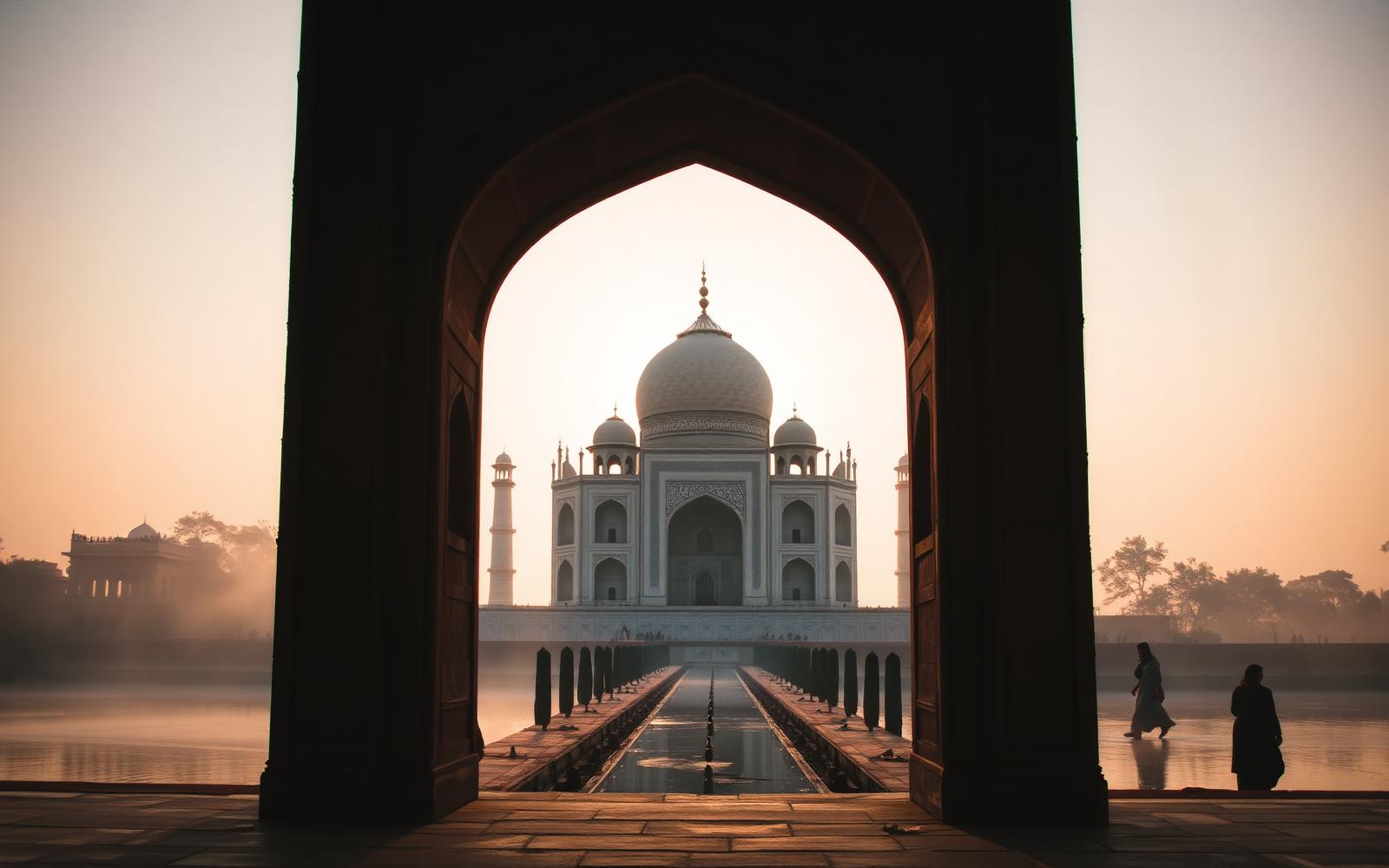
What happens instead is that you walk through the sandstone gateway — the one deliberately built to frame the Taj like a keyhole, so the whole thing arrives on you at once rather than creeping into view — and something in your chest does a small, involuntary drop. Not awe exactly. Awe is too loud a word for it. It's closer to what happens when a room goes quiet without anyone asking it to.
This isn't a pretty building. It's a very large, very controlled scream.
That's the part the photographs never carry over: the Taj is not a monument to love in the greeting-card sense. It's a monument to refusal. Shah Jahan lost Mumtaz Mahal in childbirth — their fourteenth child — and instead of grieving quietly, he spent twenty-two years and the labour of twenty thousand people making sure the world would never be allowed to forget the shape of his loss.
The light changes it through the day, and this is a fact worth planning around. At sunrise the marble is a pale rose-gold, almost shy, mist still sitting low over the Yamuna behind it. By late morning it's gone hard white, almost too bright to hold your gaze, the way grief itself goes cold and clinical in daylight. At sunset it softens into amber, and on the five nights a month when night viewing is permitted around the full moon, it turns the colour of old bone under moonlight.
Get close enough and the register shifts again. The pietra dura inlay — thousands of semi-precious stones cut and set into marble to form flowers that never wilt — turns the grief personal rather than architectural. Someone spent years bent over these panels, and you find yourself forgetting the crowd, the heat, the train you have to catch, and just looking.
Beyond the Taj
It's easy to treat Agra as a one-monument city — fly in, see the Taj, fly out. That's a mistake. Agra Fort sits a few kilometres upstream and deserves half a day, not the rushed hour most itineraries give it. This is where the story gets its bitter twist: Shah Jahan's own son, Aurangzeb, overthrew him and kept him under house arrest in a tower called Musamman Burj for the last eight years of his life, from which he could see the Taj but never touch it again.
Mehtab Bagh, the moonlight garden directly across the river, gives you the view every photographer actually wants — the monument reflected in still water, without the crowds pressing against the marble. Fatehpur Sikri, forty kilometres out, is a red sandstone ghost city Akbar built as his capital and abandoned within fifteen years. And Itmad-ud-Daulah's Tomb, the 'Baby Taj', was the rehearsal for everything the Taj would later become — smaller, quieter, and best at golden hour.
What we would actually do with two days
Sunrise at the Taj, at the gates before opening. A full slow morning at the fort, ending in the Musamman Burj with the story told properly. Fatehpur Sikri for a half-day with a licensed guide. An hour in a marble inlay workshop in the old city, because watching the technique done by hand changes how you look at the monument afterwards. Petha from a family shop near Sadar Bazaar, kebabs in the evening, and sunset from Mehtab Bagh across the water.
Agra doesn't ask you to admire it the way most cities do. It asks you to sit with something uncomfortable — the size of one man's refusal to let go — and somehow, that's what makes it beautiful.
Curious what a trip through Agra could look like?